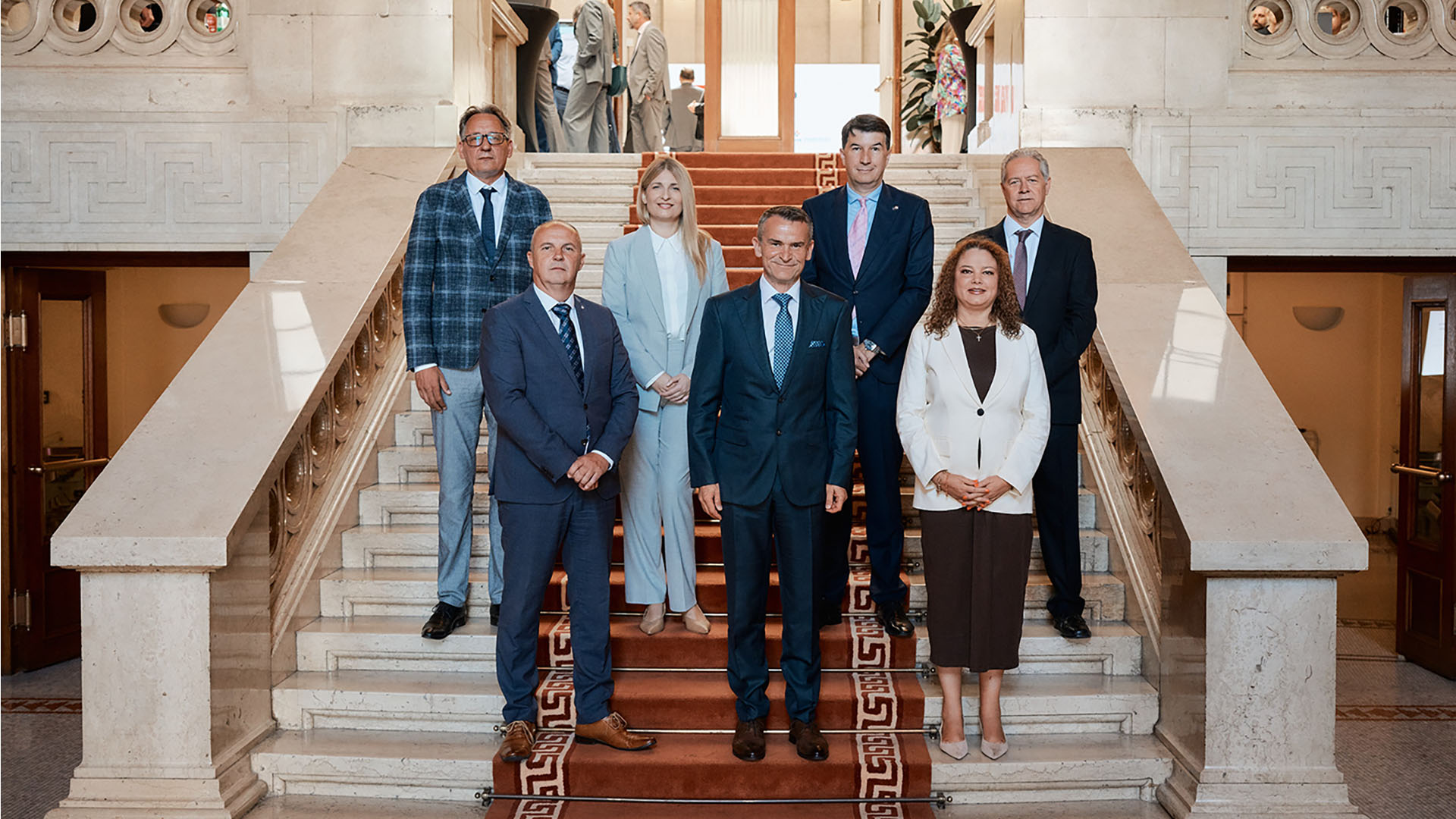
The second annual meeting of regulatory authorities, held today at the CNB, gathered representatives of the institutions of the regulatory system of the Republic of Croatia with the aim of exchanging experiences, identifying common challenges and improving cooperation. The meeting was attended by the representatives of the Agency for Media (AEM), the Personal Data Protection Agency (AZOP), the Agency for the Protection of Market Competition (AZTN), the Croatian Financial Services Supervisory Agency (Hanfa), the Croatian Energy Regulatory Agency (HERA), the Croatian National Bank (HNB) and the Croatian Regulatory Agency for Network Activities (HAKOM). The main theme of this year's meeting was the impact of global instability on the work of regulatory authorities, with a particular emphasis on cybersecurity.
Participants were welcomed by Ante Žigman, CNB Governor, Ante Šušnjar, Minister of Economy, Tomislav Ćorić, Deputy Prime Minister and Minister of Finance in the Government of the Republic of Croatia, and Tonko Obuljen, President of the HAKOM Council.
“In times of crisis, citizens are not concerned with where one institution's responsibility ends and another's begins. They are interested in whether they can make payments, access their money, use basic services and obtain reliable information. That is precisely why maintaining trust and the cooperation of regulators is becoming one of the key prerequisites for trust and stability”, CNB Governor Ante Žigman emphasised on that occasion.
In his opening address, Deputy Prime Minister and Minister of Finance Tomislav Ćorić praised the organisation of the conference as a valuable opportunity for constructive dialogue and strengthening cooperation between institutions that share a common responsibility towards citizens and the economy.
“The risks we have been facing for some time no longer stem exclusively from economic developments. In addition to financial cycles and market disruptions, today the regulatory system must respond to cyberattacks, geopolitical instability, the rapid development of artificial intelligence and keep pace with the ever-stronger interconnectedness of financial, energy and various digital systems. It is a good thing that regulatory institutions are increasingly focusing on these new challenges and threats, but they must never forget their core, traditional task – to consistently ensure legality, stability, transparency and a level playing field for all market participants. In recent years, the Republic of Croatia has made significant strides in strengthening institutional resilience, and joining the euro area and the Schengen area, along with the process of joining the OECD, is part of the same strategic framework in which regulators participate on a daily basis. Therefore, their work not only affects the trust of the domestic public, but also sends a clear message to foreign partners about the level of the rule of law and predictability of the regulatory environment, while inter-institutional cooperation becomes just as important as the expertise of each individual regulator", said Minister Ćorić.
Ante Šušnjar, Minister of Economy, stated in his presentation that the development of the Croatian economy required clear rules, strong institutions and a regulatory system capable of keeping pace with changes in the market. “This is particularly important in the energy sector, where security of supply and a stable regulatory framework directly affect citizens, entrepreneurs and industry. The same applies to consumer protection, because a regulated market means that citizens know their rights”, said Minister Šušnjar. Speaking about technological changes, the minister emphasised that artificial intelligence, digital platforms and cybersecurity directly affected the economy and required regulatory solutions that would keep pace with technological development. “It is important that regulatory authorities exchange experiences and develop solutions that will protect citizens, ensure stable conditions for investment and contribute to the competitiveness of the Croatian economy", said Šušnjar.
HAKOM Council President Tonko Obuljen stressed that this conference provided an opportunity to connect different perspectives: communication infrastructure, financial stability, operational resilience, incident management and accountability of institutions.
“Resilience is not a state we achieve once and for all. It is the ability to adapt continuously. Threats are changing faster than regulatory cycles, technologies are evolving faster than procedures, and attackers are increasingly using automation, artificial intelligence and social engineering to bypass traditional defence mechanisms. Our goal cannot be the promise of absolute security. Such a promise would not be realistic. The aim must be to reduce the likelihood of serious incidents, limit their impact when they occur, ensure the continuity of key services and preserve the trust of users and the public", Obuljen said in his presentation, noting that without reliable communication networks there could be no stable digital economy.
The opening presentation "When Cyberattacks Become Weapons: Implications for Regulators" was held by Anamarija Staničić, Deputy President of the Board of Hanfa, who spoke about the increased level of global uncertainty and systemic risks, which leads to an erosion of the predictability of the regulatory environment, with the result that regulators no longer operate in a stable environment, but in a ‘perma-crisis’ environment. The financial sector is a prime target for cyberattacks, and the role of regulators is twofold: overseeing market stability and working on their own resilience. The presentation outlined Hanfa’s approach to cybersecurity, with a particular focus on developing resilience, human capacity, preventive measures and collaboration with relevant stakeholders.
The panel discussion "The Impact of Global Instability on the Work of Regulatory Authorities" featured Josip Popovac, President of the Media Council, Zdravko Vukić, Director of AZOP, Mirta Kapural, President of the AZTN Council, Nikola Vištica, President of the HERA Governing Council, Tonko Obuljen, President of the HAKOM Council and CNB Governor Ante Žigman. The panellists exchanged experiences on the challenges regulatory authorities face in the context of heightened geopolitical, technological and security risks, and emphasised the importance of inter-institutional cooperation, knowledge sharing and coordinated action in strengthening the resilience of the Republic of Croatia's regulatory system.
The panel highlighted the need for the resilience of communications infrastructure to be viewed as an intersectoral issue, as electronic communications networks, internet access, interconnection, data flows and digital services constitute the core infrastructure on which finance, energy, transport, healthcare, public administration, the security system and numerous other activities of crucial importance for the functioning of the society and economy rely. This is precisely why the regulatory response to such risks must be coordinated. In a real-world incident, the user does not always distinguish whether the problem originated with the bank, an electronic communications operator, a cloud computing service provider, a software supplier, or a public institution. Citizens and businesses are primarily concerned with whether the service is working, whether they can communicate, make a payment and get reliable information. This requires clear protocols, regular exercises, timely exchange of information and cooperation between regulators, operators, financial institutions, government authorities and European partners.