
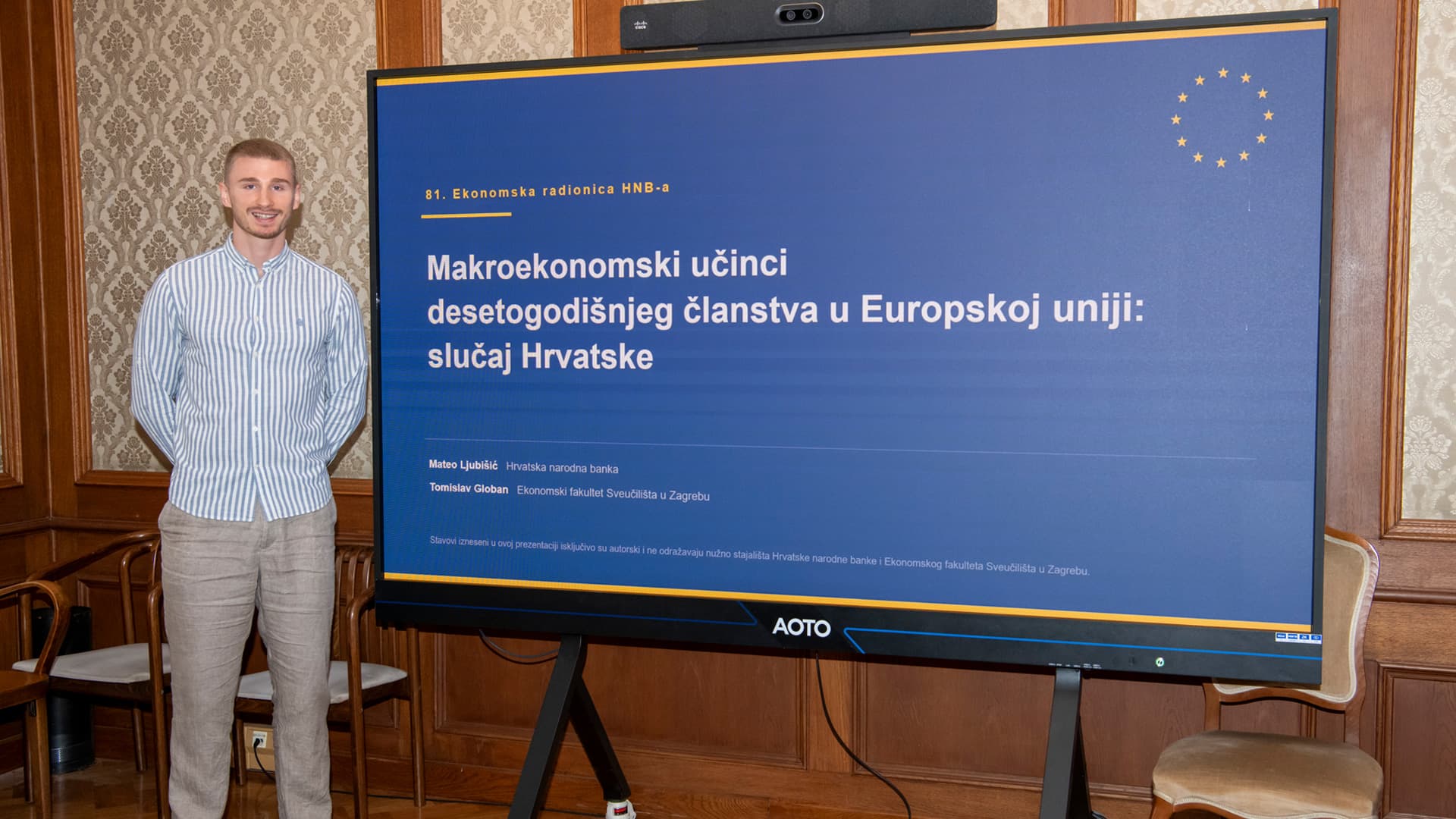
Mateo Ljubišić from the Economic Analysis Department presented the paper entitled "Macroeconomic effects of a decade-long EU membership: evidence from Croatia"
At the 81st CNB Economic Workshop held today, Mateo Ljubišić from the CNB's Economic Analysis Department presented the paper entitled "Macroeconomic effects of a decade-long EU membership: evidence from Croatia", co-authored with prof. Tomislav Globan (Faculty of Economics and Business Zagreb), published in Post-Communist Economies.
The paper examines the macroeconomic effects of Croatia’s EU membership during its first decade. Using the synthetic control method for constructing a scenario without integration, the study estimates synthetic values for key real indicators, including GDP, aggregate demand components, gross value added, labour productivity and gross national income, covering the period from 1997 to 2023.
"This is the first analysis that covers the full ten years of Croatia’s membership in the European Union and compares actual trends with an estimate of how the Croatian economy would have fared if we had not joined the EU. Positive effects are visible in GDP per capita, exports and citizens’ incomes, while it is particularly important to note that these effects have been more intense after joining the euro area and Schengen area and with the record-breaking utilisation of EU funds. The paper also shows that the benefits of the integration are not automatic, but instead depend on domestic policies, reforms and the ability to use EU funds efficiently. Croatia's experience is therefore also relevant for the Western Balkan countries aspiring to join the EU", said Globan.
The comparison of real and synthetic values has revealed significant positive effects, especially in terms of exports, imports, investments, GVA in the tertiary sector and gross national income, with effects intensifying over time. Despite the constraints caused by macroeconomic imbalances before the accession, the cumulative benefits of membership are substantial. Robustness was confirmed through placebo tests in time and space. The study also highlights the deepening of the degree of integration, including the entry into the euro area and the Schengen area, alongside increased inflow of EU funds, as key drivers for enhancing the positive outcomes post-2020. These findings underscore the transformative role of EU membership and point to new research directions on the broader economic implications of the milestones in Croatia’s integration.

"The research has shown significant and growing positive effects of the ten-year membership on real economic indicators in Croatia, which confirms that the benefits of the integration over the medium term are still accumulating. The most pronounced spillover channel is the trade channel, but partly also the capital channel, which is further driven by EU funds. Further positive effects will depend on structural reforms and institutional capacity in Croatia, but also on the ability of the European Union to keep pace with rapid technological changes", said Ljubišić.