Statistical releases provide a summary of the most recent values and trends for the published statistical indicators series compiled by the Croatian National Bank.
Financial accounts statistics for the second quarter of 2026
Within the scope of financial accounts statistics[1], the Croatian National Bank publicly releases data on stocks of financial assets and liabilities of the entire economy and individual institutional sectors – non-financial corporations, households, general government and financial sector, in a certain period. Financial net worth of the economy or any part thereof is calculated as the difference between the stocks of its financial assets (e.g. loans and deposits granted, investments in securities and holdings) and the stocks of its financial liabilities (e.g. loans and deposits received, issued securities), with the total financial liabilities including debt liabilities, as well as the estimated financial worth of capital.
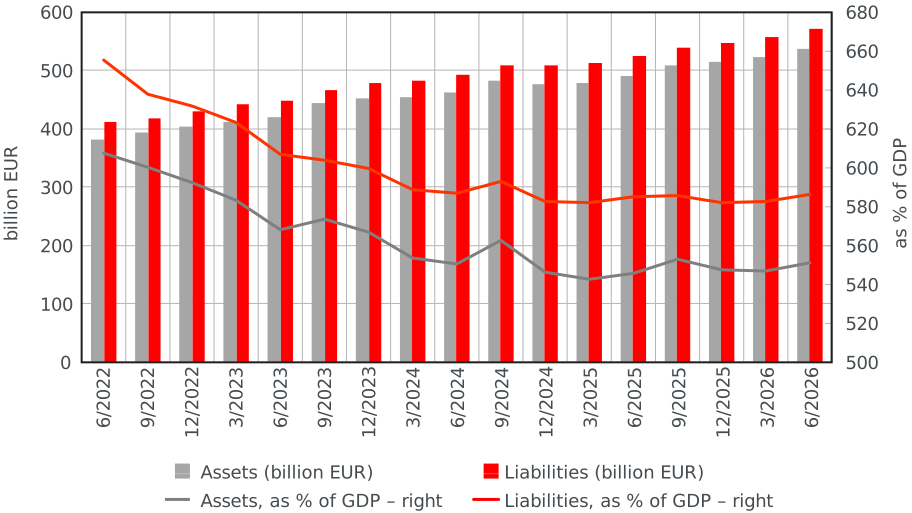
At the end of the second quarter of 2026, the financial assets of the Croatian economy stood at EUR 537bn (Figure 1), up by EUR 14.0bn in the quarter concerned and up by EUR 46.5bn in the period of one year. The financial liabilities of the Croatian economy stood at EUR 571bn, up by EUR 14.5bn in the quarter concerned and up by EUR 45.4bn in the period of one year. In terms of GDP, at the end of the second quarter of 2026, the financial assets of the Croatian economy amounted to 551% of the annual GDP, up by 4.0 percentage points in the quarter concerned and up by 5.6 percentage points in the period of one year. At the same time, the financial liabilities of the Croatian economy increased by 3.8 percentage points in the quarter concerned and by 1.5 percentage points in the period of one year, accounting for 586% of the annual GDP at the end of the second quarter of 2026.
Figure 1 Financial assets and financial liabilities of the Croatian economy
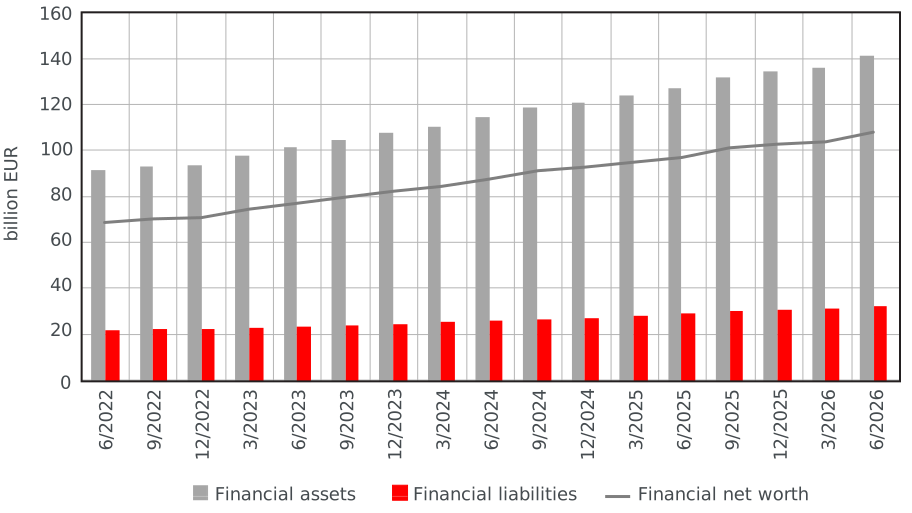
At the end of the second quarter of 2026, the total financial assets and financial liabilities of households stood at EUR 141bn and EUR 33bn, respectively (Figure 2), which is an increase of 3.7% and 3.0% from the end of the previous quarter, while in the period of one year, the financial assets of households increased by EUR 14.1bn which is an increase of 11.1% and the financial liabilities of households increased by EUR 3.2bn or 10.6%. As a result, the financial net worth of the household sector amounted to EUR 108.3bn or 3.9% more than at the end of the previous quarter (i.e. EUR 11.0bn or 11.3% more than at the end of the same quarter of the previous year).
Figure 2 Financial assets and liabilities of the household sector[2]
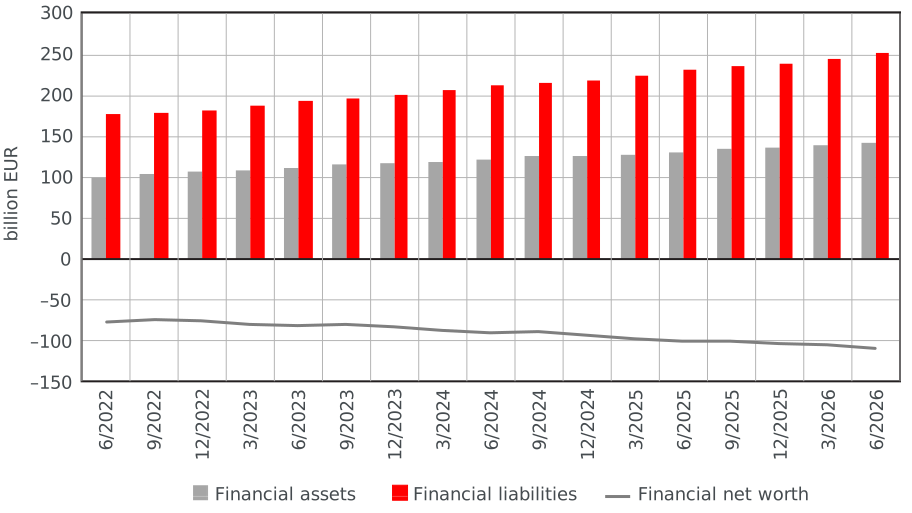
At the end of the second quarter of 2026, the total financial assets of non-financial corporations stood at EUR 143bn (Figure 3), growing by 2.9% from the end of the previous quarter. The financial liabilities of non-financial corporations amounted to EUR 252bn or 3.1% more than at the end of the previous quarter. In line with such developments, the financial net worth of the non-financial corporations sector decreased to EUR –109.1bn, down by EUR 3.5bn from the end of the previous quarter.
Figure 3 Financial assets and liabilities of the non-financial corporations sector
Statistical time series: Financial accounts
-
Financial accounts statistics shows the indicators of stocks, transactions, valuation adjustments and other changes in financial assets and liabilities in the economy, classified by sectors and by financial instruments, on the basis of the currently available data sources. These include the CNB's monetary statistics and external statistics, statistical reports of the Croatian Financial Services Supervisory Agency, annual reports of non-financial corporations collected by the Financial Agency, reports on general government equity holdings in corporations by the Ministry of Finance of the Republic of Croatia, Ministry of Physical Planning, Construction and State Assets and the Centre for Restructuring and Sale (CERP), data on the general government debt by the Ministry of Finance and the CNB, as well as the Zagreb Stock Exchange trading reports. ↑
-
Apart from households, the household sector also includes non-profit institutions serving households (citizens's associations, etc.). ↑