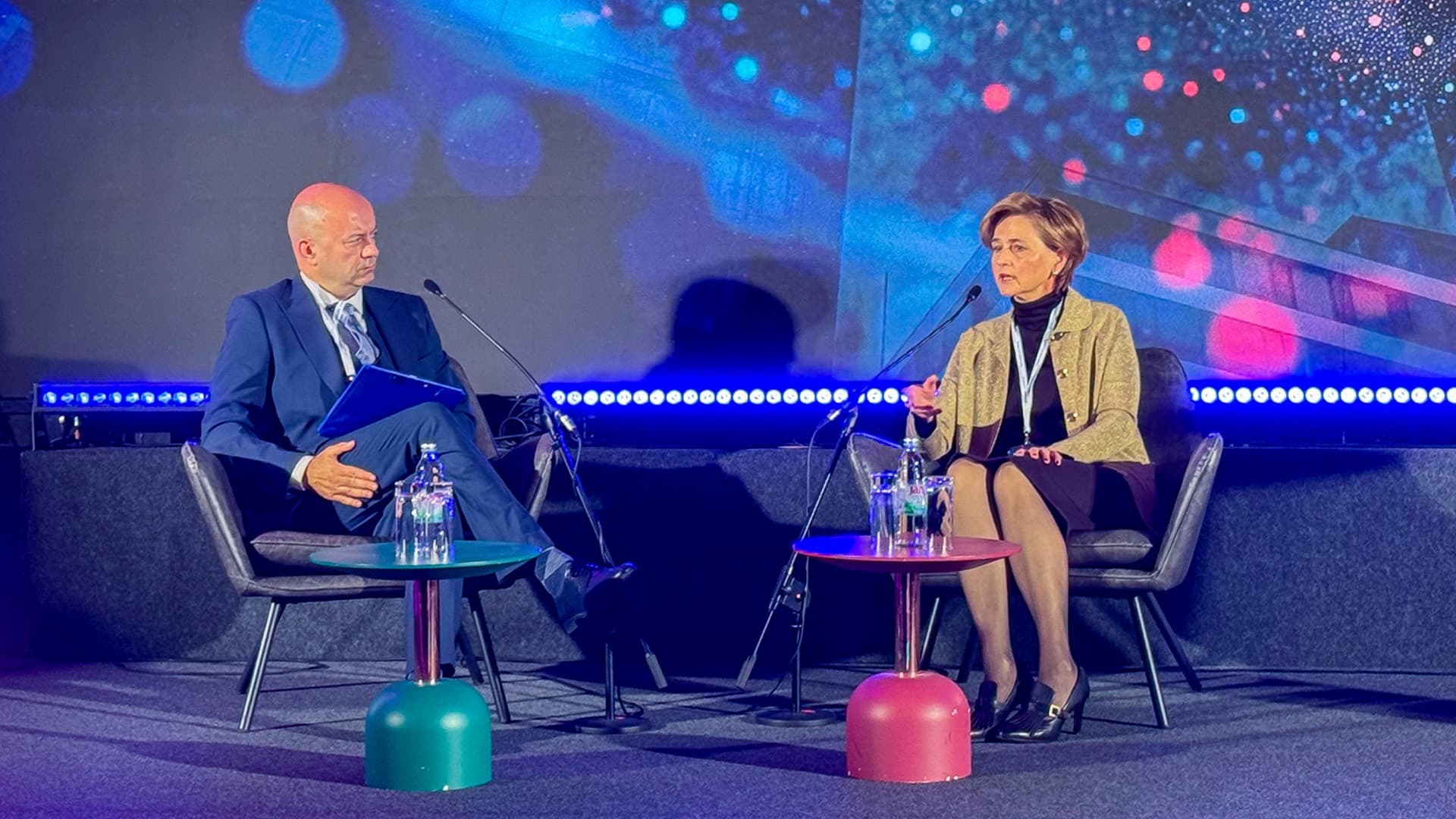
Sandra Švaljek, Deputy Governor of the Croatian National Bank, participated at the Zagreb Financial Forum conference organised by Poslovni dnevnik, where she discussed the banking system and the credit market in new economic circumstances with Mladen Miletić, Editor-in-Chief at Poslovni dnevnik.
On the topic of inflationary developments and possible further monetary policy responses, the Deputy Governor noted that the European Central Bank, owing to heightened price pressures, had already raised its key interest rates in June and September, with the rate on deposit facility rising from 2 to 2.5 per cent. She emphasised that future decisions by the European Central Bank will depend on new economic and financial data and inflation projections, and that uncertainty continues to stem primarily from energy price movements and geopolitical circumstances.
Speaking about the pass-through of higher interest rates to financing conditions, Sandra Švaljek warned that their effects are already being felt, particularly in corporate loans, which are more exposed to interest rate changes due to a larger share of loans with variable interest rates and shorter maturities.
With regard to inflation in Croatia, the Deputy Governor noted that the mentioned tightening of the Eurosystem’s monetary policy suits Croatia, as the business cycles of Croatia and the euro area as a whole are now well aligned. This contributed to a reduction in the inflationary differential, which, according to the first estimate of the harmonised index of consumer prices in October, stood at 0.4 percentage points, the lowest since the start of 2022. She added that, so far, the stronger pressures from energy prices have not spilled over into other prices, and that there are not yet any more pronounced secondary inflationary effects related to wage growth and inflation expectations.
Speaking about the real estate market, Švaljek warned of a sharp rise in prices, which have increased by 75 per cent cumulatively over the past five years. She pointed out that disruptions in that market could have negative consequences for financial stability, given banks’ exposure to the construction sector and real estate-related activities, as well as the large share of housing loans secured by real estate.
Commenting on ways of financing businesses and investments, the Deputy Governor noted that, despite the bank-centricity of the Croatian financial system, the majority of corporate investments are financed from their own funds. Own funds account for 78 per cent of total investment financing, while small and medium-sized enterprises are financed by bank loans in only about one third of cases. She highlighted the potential for the development of the capital market, its deepening and regional integration, noting that it will continue to be a supplementary, rather than the dominant, source of financing for businesses.
In conclusion, she warned of cyber risks as one of the most significant threats to the financial system and emphasised the importance of strengthening the resilience of banks’ information systems against cyber-attacks. She also emphasised the need to preserve banks’ capitalisation, which in Croatia remains good, with an overall capital ratio of around 22 per cent, but is declining year on year. Given the high dividend payouts over the past two years, she said it was important to preserve banks’ capital so they could absorb any unforeseen losses and maintain resilience in future challenging circumstances.