
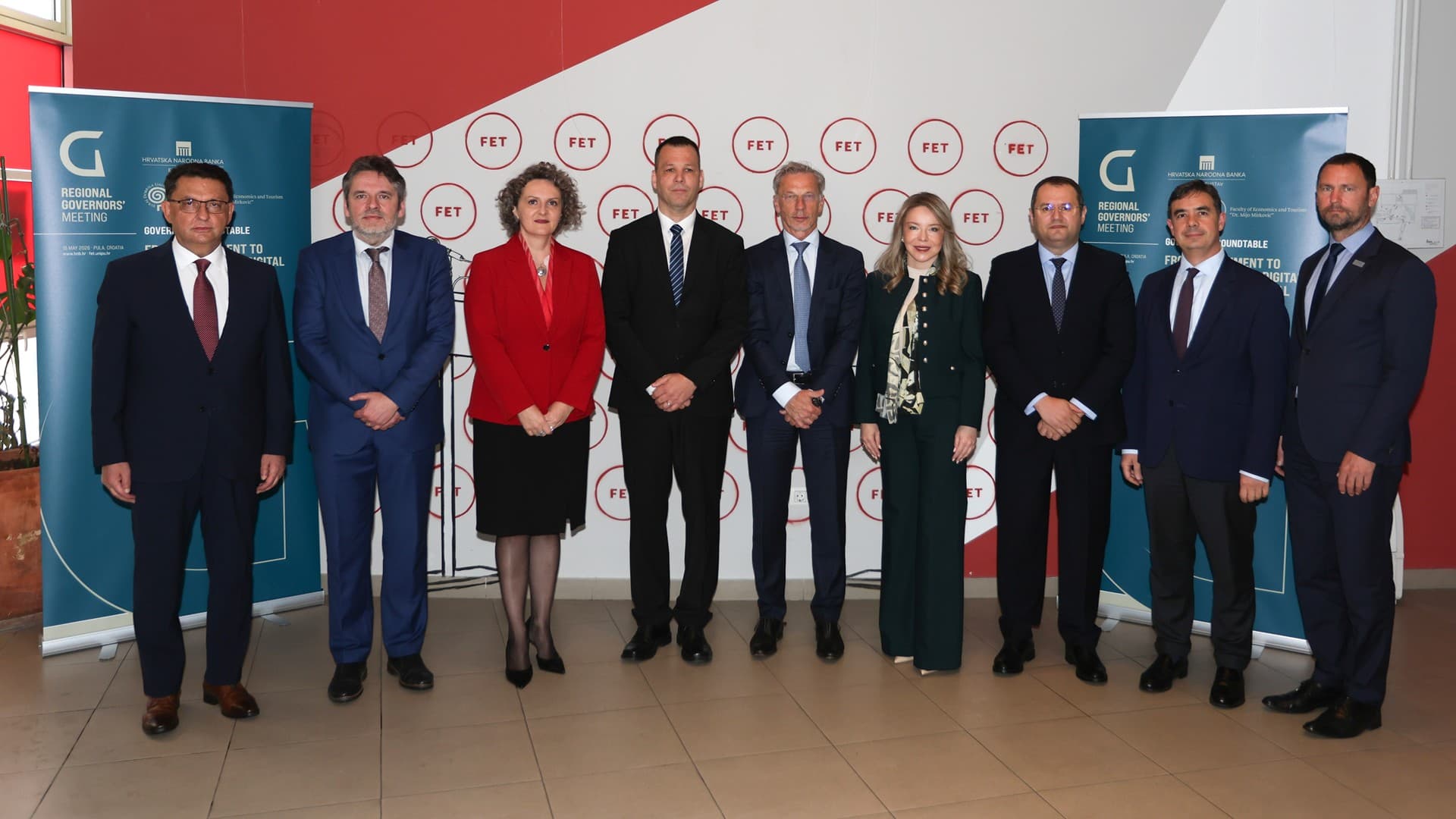
Pula hosted today the Regional Governors’ Meeting, organised by the Croatian National Bank in cooperation with the Faculty of Economics and Tourism "Dr. Mijo Mirković". Governors took part in a round table discussion on the following topic: "From Experiment to Infrastructure: Digital Assets in Traditional Financial World".
Ahead of the discussion, the guests were greeted by Ticijan Peruško, Dean of the Faculty of Economics and Tourism "Dr. Mijo Mirković", Peđa Grbin, Mayor of Pula, and Jessica Acquavita, Deputy County Prefect of the Istria County. Brunello Rosa, the CEO and Head of Research at Rosa & Roubini Associates delivered the keynote speech on digital currencies and their geopolitical implications.
The panellists – Boris Vujčić, Governor of the Croatian National Bank, Primož Dolenc, Governor of the Bank of Slovenia, Ahmet Ismaili, Governor of the Central Bank of the Republic of Kosovo, Irena Radović, Governor of the Central Bank of Montenegro, Jasmina Selimović, Governor of the Central Bank of Bosnia and Herzegovina, and Trajko Slaveski, Governor of the National Bank of the Republic of North Macedonia – discussed whether and how digital assets could be integrated responsibly into the traditional financial system. They also discussed how to implement the integration without compromising financial stability, consumer protection and monetary sovereignty. It was pointed out that the question is no longer whether digital assets would come into contact with traditional finances, but whether this contact would be shaped by policies and trust or by crisis and fragmentation. The governors also looked at the main causes of elevated inflation and the possibility of different scenarios in the current global geopolitical and economic situation.
Boris Vujčić noted that inflation in Croatia had grown rapidly since the beginning of the year, primarily driven by the external energy price shock following the outbreak of the war in the Middle East. Energy inflation was already elevated before the beginning of the war, reflecting the delayed withdrawal of subsidies for electricity, gas and heating compared with other countries. In contrast, food inflation slowed down to 3.7% in April, after growing from 3.2% in January to 3.9% in February and to 4.0% in March.
The Governor pointed out that core inflation fell from 3.9% in the first two months of the year to 3.7% in April. "A decline in core inflation (excluding energy and food prices) pushed industrial goods inflation down from –0.2% in February to –0.7% in March and April, the lowest level since early 2020. By contrast, services inflation, which contributes the most to overall inflation, remained persistent at 2.4 percentage points. After remaining stable at 7.2% for the three consecutive months to March, services inflation edged up to 7.3% in April. The stagnation in services inflation, however, masks divergent trends between market-based and administered prices for services, with market services inflation gradually declining and inflation of administered services, such as rents, road tolls, dental services, medical services, waste collection and sewerage, rising. Persistently elevated services inflation reflects a steadily robust labour market with a low unemployment rate and ongoing, albeit slowing, growth in employment and wages, as well as still-buoyant domestic demand, with increased consumer preferences for services", Vujčić stressed.
Referring to the digital euro project, he argued that its implementation would not lead to elimination of cash; instead, the digital euro would be a digital complement to cash, rather than an investment asset or substitute for bank deposits. He also added that the introduction of a digital euro would strengthen Europe’s strategic autonomy by reducing dependence on a few non-European card schemes, technological platforms and potentially stable foreign currencies.
Commenting on the implications of privately issued digital currencies and stablecoins for monetary sovereignty and stability of national currencies, it was noted that stablecoins are not an immediate systemic threat to the euro area; however, in the context of the USD concentration and network effects, they are a strategic issue for monetary sovereignty, monetary policy transmission and financial stability. "While stablecoins have moved from a niche crypto-market instrument to a broader payment and clearing infrastructure, their use in daily payments remains limited across both the euro area and in Croatia. The market is highly concentrated in USD instruments: global capitalisation of USD-denominated stablecoins rose from over USD 130bn in late 2023 to over USD 300bn in early 2026, while that of euro-denominated stablecoins remains very low, at around EUR 600m. If adopted more broadly, stablecoins could weaken monetary transmission by shifting funds from bank deposits, and changing banks’ liquidity management and the pass-through of interest rates to deposit and lending conditions. However, the regulation on the crypto-asset market (MiCA) has significantly reduced these risks in the EU through safety reserves, redemption, publication and authorisation requirements. Therefore, policy needs to be balanced: there is no immediate systemic threat, but the authorities should closely monitor the growth of stablecoins, maintain confidence in the euro, implement MiCA effectively and support European public and private payment solutions, including the digital euro," the Governor noted.
When asked what real financial integration in the EU could look like in the next five to ten years and what factors would affect its course the most, the Governor said that real integration would be gradual and multi-faceted, rather than a sudden transition to fully homogeneous financial markets. "The fastest and most visible progress is likely to be in payments: real-time payments should become the norm in the euro area, but real integration depends on user experience, merchants’ acceptance and pan-European reach. Pan-European end-user solutions are crucial. Otherwise, Europe might have an advanced payment infrastructure in the background, with individuals and merchants still depending on fragmented national schemes or non-European global providers. The decisive factor is likely not only technology, but rather the continued political commitment of EU Member States to subordinate national preferences to a truly integrated European financial system", the Governor concluded.
Ticijan Peruško, Dean of the Faculty of Economics and Tourism "Dr. Mijo Mirković", said that the Governors’ Meeting in Pula was an important event, both for the faculty and the economy as a whole. "We bring together leaders with great responsibility for financial stability and economic development. This year’s theme covering digital assets is particularly relevant, as we are all aware of rapid changes in the financial system. Digital assets are no longer just an experiment, they have increasingly become part of the traditional financial world. In this context, we need an open conversation and cooperation today and solutions based on knowledge, experience and trust. That’s why it is important that such a meeting takes place at a faculty, i.e. a place for learning, debating, exploring and creating new ideas. This is a special opportunity for our students, as they can hear the views held by leaders of monetary institutions and thus better understand the real challenges of the financial system. I believe that this meeting will further strengthen cooperation between the institutions in the region and yield useful conclusions", Ticijan Peruško noted in his speech.
After the panel, the governors answered the questions of students who attended the meeting.